

Primary Maths Teacher’s Guide To The Bar Model: How To Teach It And Use It In KS1 And KS2

A bar model is a pictorial representation of a maths problem where rectangular bars represent known and unknown quantities. As the NCETM puts it, a bar model is “not a method for solving problems, but a way of revealing the mathematical structure within a problem and gaining insight and clarity to help solve it.” Bar modelling is the process of drawing and using these bar models to solve problems – and it is one of the most effective tools in a primary teacher’s repertoire for building children’s problem solving and reasoning skills.
This guide covers everything you need to teach bar model maths confidently across your school: the three core bar modelling structures, worked examples from Year 1 to Year 6, common mistakes to watch for, and a year-by-year progression to help you plan bar modelling across key stages.
Key takeaways
- A bar model is a pictorial representation where rectangular bars represent known and unknown quantities in a maths problem
- There are three core bar model structures: part-whole, comparison, and equal groups – each suited to different types of problem
- Bar modelling sits at the pictorial stage of the CPA approach and is central to maths mastery teaching
- Children can use bar models from Year 1 (simple addition and subtraction) through to Year 6 (equations, ratio, and multi-step SATs problems)
- The bar model method originated in Singapore in the 1980s and has a strong evidence base supported by the NCETM and EEF
What is a bar model in maths?
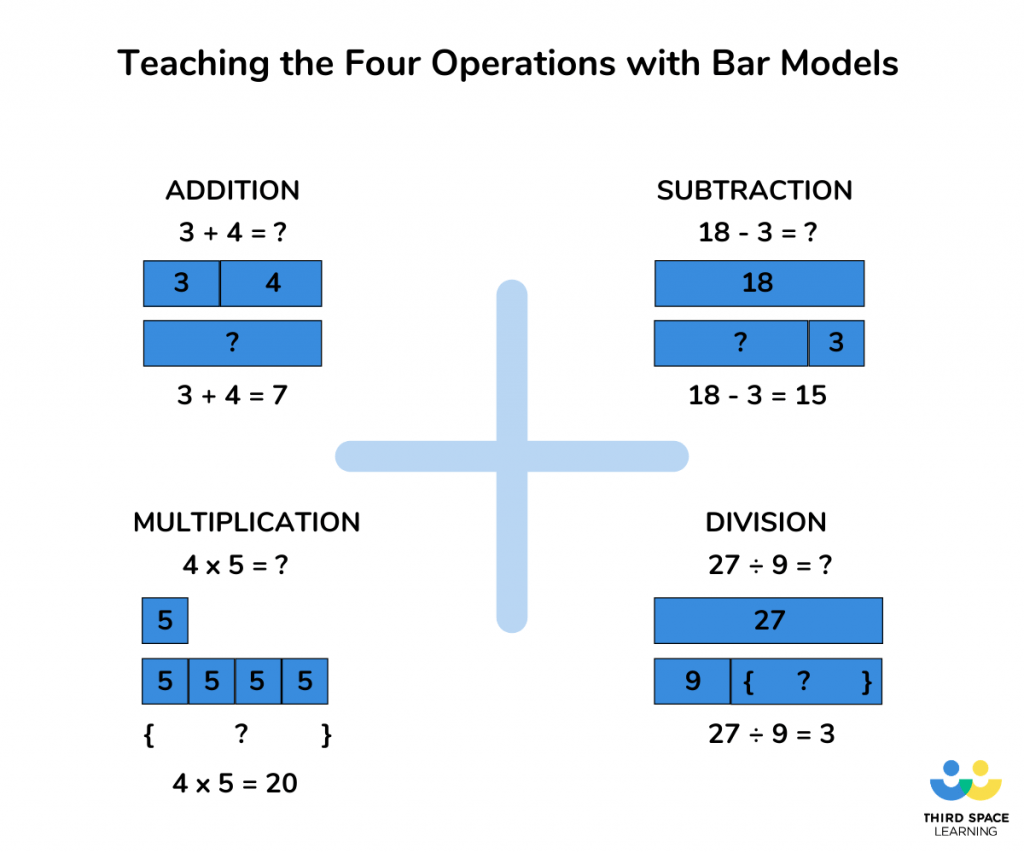
In maths, a bar model is a visual representation where bars or boxes are used to represent the known and unknown quantities in a problem. Bar models are most often used to solve word problems with the four operations – addition and subtraction, multiplication and division – but they also support children’s understanding of fractions, ratio, proportion, and algebra.
Bar models help children visualise problems and decide which calculations to carry out. A bar model shows the mathematical structure of a problem – it does not provide the answer to a question but shows children what operations are needed to solve it.

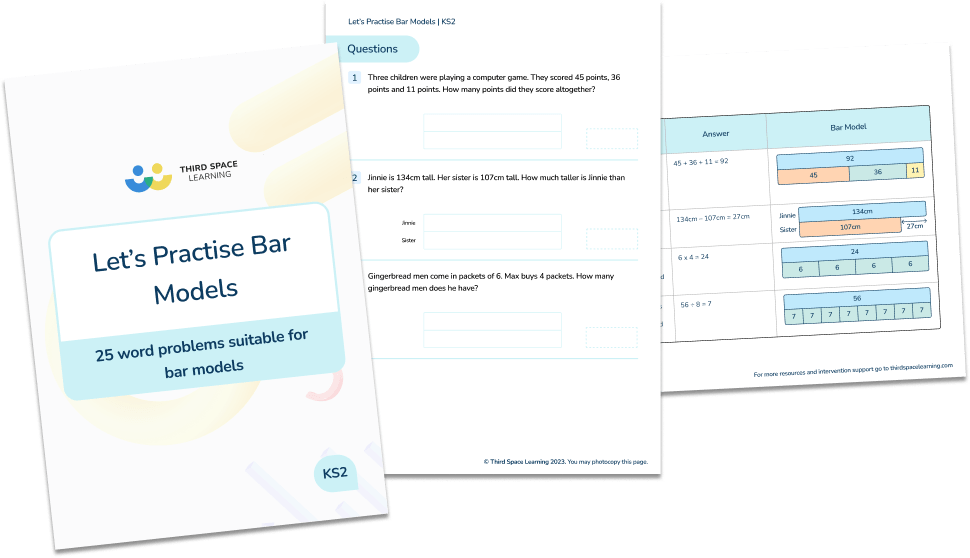
[FREE] Let's Practise Bar Model Word Problems KS2
25 scaffolded bar model word problems on the four operations. Questions suitable for Year 3 to Year 6.
Download Free Now!Bar models and the CPA approach
The bar model is central to maths mastery and sits at the pictorial stage of the concrete pictorial abstract (CPA) approach. Children work with concrete objects first, then use bar models as pictorial representations before moving to abstract number sentences and equations.
This is one of the reasons bar models feature so prominently in maths intervention programmes – including one to one tutoring from Skye, Third Space Learning’s AI maths tutor. The lessons are designed following a Concrete Pictorial Abstract CPA approach where scaffolding is gradually removed as students progress through the “I do, we do, you do” stages. A bar model is integral to this approach.
What does ‘bar modelling’ mean?
Bar modelling is the term for the process of drawing and using bar models to answer maths questions. When we ask a child to “bar model a problem”, we are asking them to represent the known and unknown amounts as rectangular bars, then use that bar modelling method to work out what calculation is needed.
An understanding of bar models is essential for solving all sorts of word problems, from simple addition in Year 1 through to multi-step problems in the KS2 SATs.
The three types of bar model
There are three core bar model structures that children need to learn. Each represents a different mathematical relationship, and knowing which model to use is a key part of bar modelling.
Part-whole model
The part-whole model (also called the part-whole method) shows how different parts combine to make a total (the whole). It is the most common bar model and is used for addition and subtraction problems where children need to find a missing part or a missing whole.
There are two ways to draw a part-whole bar model:
- As discrete parts to a whole – each unit has its own individual box, similar to Numicon cubes
- As continuous parts to a whole – units are grouped into one bar for each amount in the problem, so 26 would be one long bar rather than 26 smaller rectangles joined together
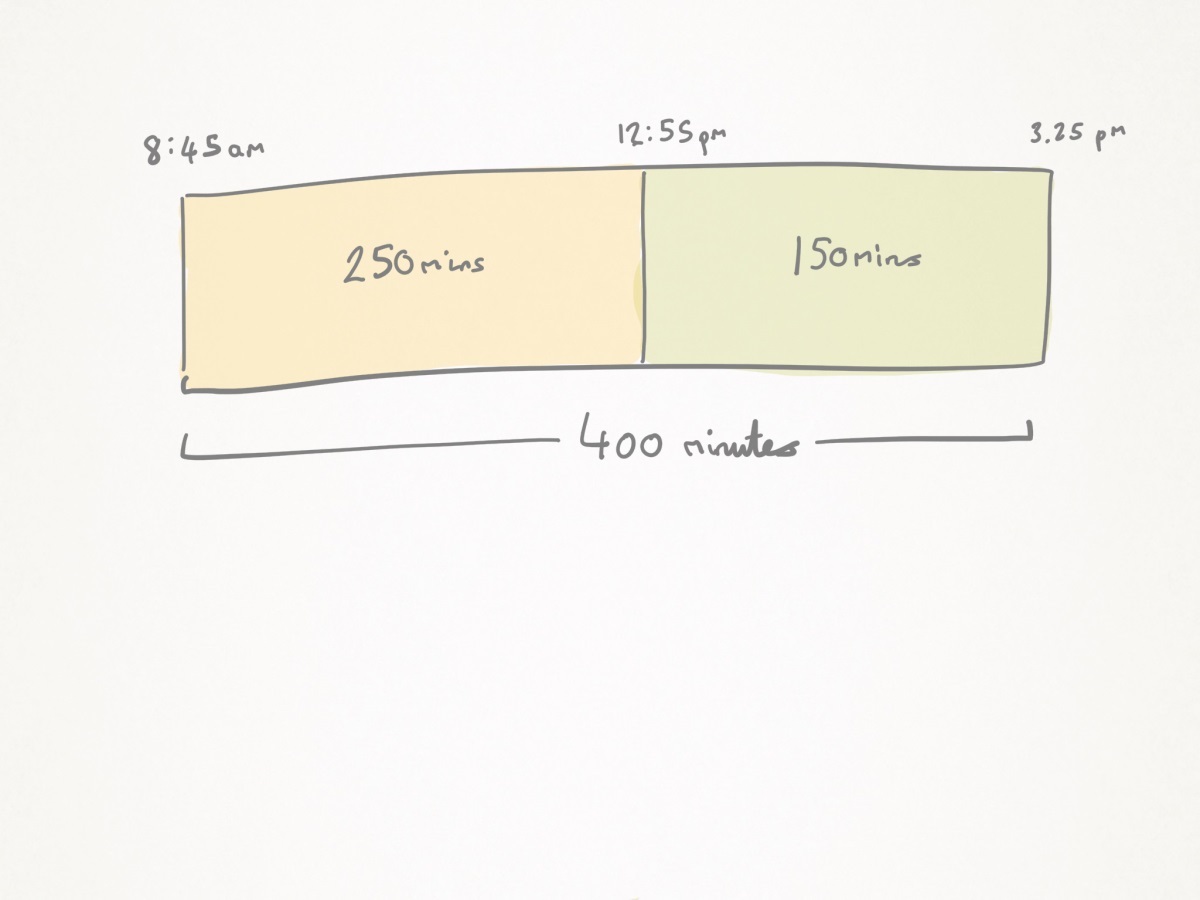
When drawing a part-whole bar model, proportionality matters – all bars must be roughly proportional to each other, so 6 should be about twice the length of 3. That said, children do not need to use rulers. Hand-drawn bars that are approximately proportional are fine for classroom use; the purpose is to reveal the structure, not to produce a perfect diagram.
The part-whole method is used to represent addition, subtraction, fractions, measure, algebra, and ratio. Bar modelling with the part-whole method teaches children to identify the whole and its parts before choosing a calculation.
Read more: What is the part-whole model?
Comparison model
The comparison model uses two separate bars of different lengths to represent two different quantities. It is used for “find the difference” and “how many more/fewer” problems – any problem where children need to compare two quantities and find the gap between them.
The comparison model is also used for multiplication and division problems involving scaling (for example, “three times as many”) and for ratio problems where children need to see the relationship between two quantities.
Equal groups model
The equal groups model (sometimes called the scaling model) divides a bar into equal parts. Each section of the bar represents the same amount. This model is used for multiplication, division, and problems involving equal sharing or repeated addition.
When children use bar models for multiplication, they draw bars of equal size to represent each group. For division, they start with the whole bar and divide it into equal parts. Bar modelling with equal groups helps children understand the concepts of multiplication and division before moving to abstract calculations.
Knowing when to use each bar model type is an important skill. In general: if the problem asks children to combine or separate amounts, use the part-whole model. If it asks them to compare two quantities, use the comparison model. If it involves equal groups, sharing, or scaling, use the equal groups model.
Why use the bar model method in maths?
Bar modelling has a strong evidence base. The NCETM identifies bar models as a key representation for revealing mathematical structure, and Debbie Morgan (NCETM Director for Primary) has argued that “the additive structure that is revealed through the part-whole model is the same in Year 2 as it is in Year 12, so providing access to those structures through representations is absolutely key to all children being successful.”
The Education Endowment Foundation’s guidance report on improving mathematics in Key Stages 2 and 3 includes “use manipulatives and representations” as one of its eight key recommendations – but emphasises that representations need to be used purposefully and with a clear rationale, not just added for the sake of it.
The Singapore bar model method and CPA approach
The bar model method originated in Singapore in the 1980s. Dr Kho Tek Hong developed the model method as part of Singapore’s Primary Mathematics Project, and it was officially introduced into the Singapore curriculum in 1983. The approach draws heavily on Jerome Bruner’s theory of cognitive development, which describes three modes of representation: enactive (action-based, or concrete), iconic (image-based, or pictorial), and symbolic (language and number-based, or abstract).
This is the foundation of the concrete pictorial abstract approach used in maths mastery teaching today. Bar models sit squarely in the pictorial stage – they sit between concrete objects (such as counters, cubes, or real items) and abstract number sentences and equations, connecting the two.
The Singapore bar model method is widely used in schools following a mastery maths approach at all stages of the national curriculum. It works because:
- It reveals mathematical structure – children can see the relationships between quantities rather than guessing which operation to use
- It reduces cognitive load – the visual representation acts as a map, freeing up working memory for the actual calculations
- It is transferable – once children understand bar modelling, they can apply it to new maths topics year after year, from simple addition through to algebra and ratio
- It supports problem solving across the curriculum – bar models help children represent and solve problems in virtually any maths topic
How to draw a bar model
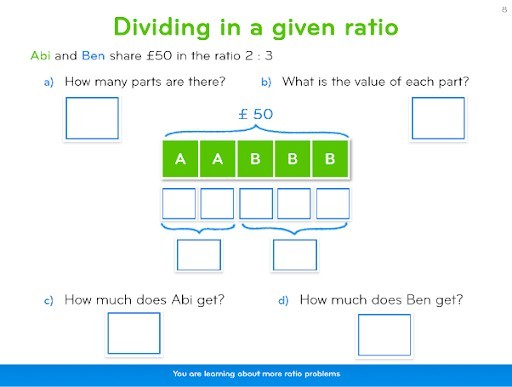
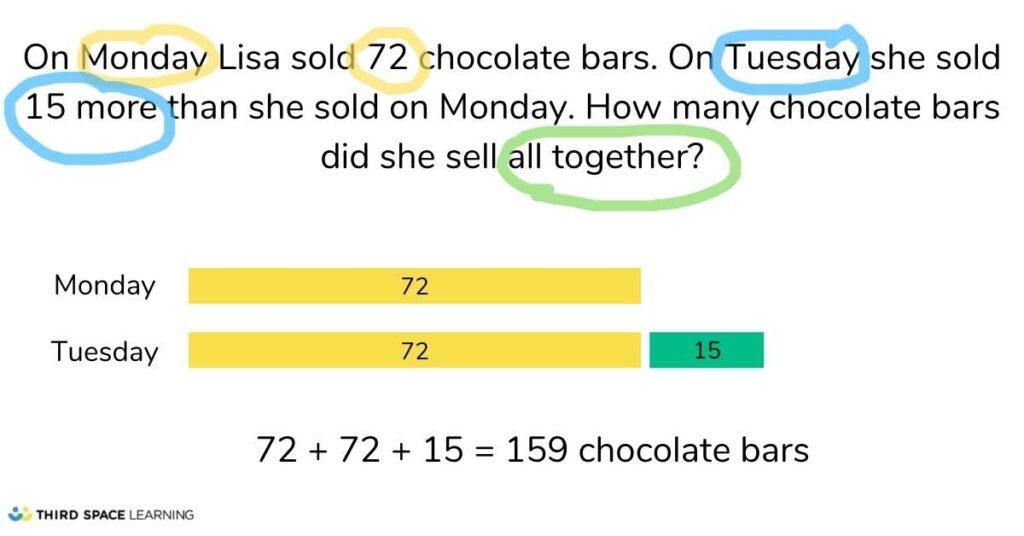
There are a few steps involved in drawing a bar model and using it to solve a problem:
- Read the question carefully
- Circle the important information
- Determine the variables – who? what?
- Decide which bar model to use – part-whole, comparison, or equal groups
- Draw the bars based on the information, keeping them roughly proportional
- Label all known amounts and mark unknown quantities with a question mark
- Re-read the problem to check the bar model matches the information given
- Identify and complete the calculation
The key question at every stage is: what do we know? Training children to ask this when they meet a word problem helps them become independent at drawing bar models. Once they can identify the known and unknown quantities, choosing the right model and solving the problem becomes significantly more straightforward.
Bar models in KS1
Bar modelling in KS1 follows a clear progression from concrete to pictorial to abstract. Children typically begin working with concrete resources and real objects, then move to pictorial representations before drawing rectangular bars.
Bar model addition in KS1
Children in Reception and Year 1 routinely come across calculations such as 4 + 3. These are often presented as word problems: Aliya has 4 oranges. Alfie has 3 oranges. How many oranges are there altogether?
To support children’s understanding of bar models, it is important to begin with concrete representations. There are two models that can be used to represent addition:
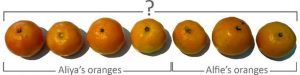
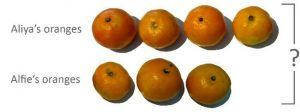
Once children are confident with real objects, replace them with representative counters (such as buttons or cubes). This intermediate step supports children in moving from concrete to pictorial:
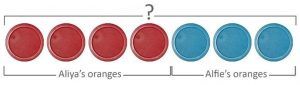
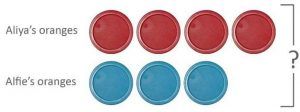
The next stage is to move to pictorial representations. Towards the end of Year 1 or the start of Year 2, children should be able to represent simple addition and subtraction word problems pictorially and assign written labels in a bar model:
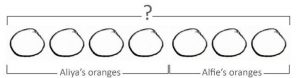
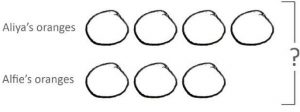
The final stage removes the 1:1 representation. Each quantity is represented approximately as a rectangular bar:
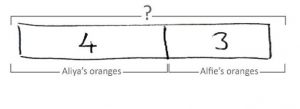
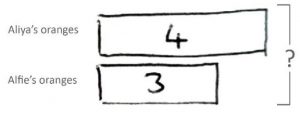
If you want children to use bar models to support them in end of Key Stage 1 SATs, they need a fair amount of experience at this final stage.
Bar model subtraction in KS1
The same concrete-to-pictorial progression applies to bar modelling for subtraction. With subtraction, teachers can nudge children towards one of two bar model representations, depending on the word problem type.
Part-part-whole: Austin has 18 lego bricks. He used 15 pieces to build a small car. How many pieces does he have left?
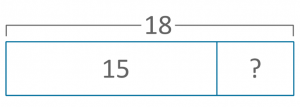
Calculation: 18 – 15 =
Find the difference: Austin has 18 lego bricks. Lionel has 3 lego bricks. How many more lego bricks does Austin have than Lionel?
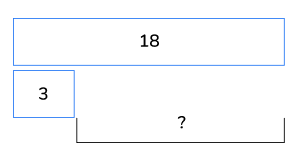
Calculation: 18 – 3 =
The part-whole method works best when children know the whole and one part, and need to find the missing part. The comparison bar model works best when children need to find the difference between two quantities. Teaching both bar modelling approaches in parallel helps children develop flexibility in their problem solving.
Bar model multiplication in KS1
Bar model multiplication follows the same concrete-to-pictorial stages as addition and subtraction. At the final stage, children draw rectangular bars of equal size to represent each group:
Each box contains 5 cookies. Lionel buys 4 boxes. How many cookies does Lionel have?
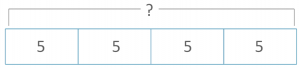
This is an example of using the bar model for repeated addition – the bar model shows children that 4 groups of 5 means 5 + 5 + 5 + 5.
Bar model division in KS1
Division is more complex, so it is worth staying with grouping and sharing using concrete resources until children are secure with bar modelling for addition, subtraction, and multiplication. Then introduce division word problems in two forms:
Sharing: Grace has 27 lollies. She wants to share them into 9 party bags for her friends. How many lollies will go into each party bag?
Grouping: Grace has 27 lollies for her party friends. She wants each friend to have 3 lollies. How many friends can she invite to her party?
Both problems use the equal groups bar model, but the unknown quantity is different: in sharing, children know the number of groups and need to find the size of each group. In grouping, they know the size of each group and need to find the number of groups.
Bar models in KS2
By Key Stage 2, children should be confident drawing bar models independently. Bar modelling in KS2 extends to more complex word problems, fractions, ratio, proportion, and equations.
Bar model for four operations word problems in KS2
Bar modelling can be used to solve multi-step word problems across the four operations. Here is an example from a sample KS2 SATs paper:
A bag of 5 lemons costs £1. A bag of 4 oranges costs £1.80. How much more does one orange cost than one lemon?
Children can represent this problem by asking “what do we know?” and drawing a bar model:
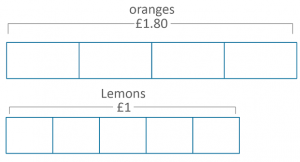
From here, children should be able to see the next step – dividing £1.80 by 4 and £1 by 5:
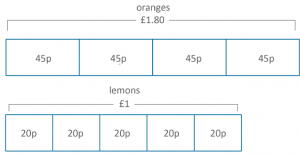
Then calculate 45p – 20p = 25p. This is a problem involving money, division, and comparison – the bar model shows children each step clearly and helps them answer the question with confidence.
Download more bar modelling questions: Let’s Practise Bar Models Four Operations
Bar model for word problems with fractions in KS2
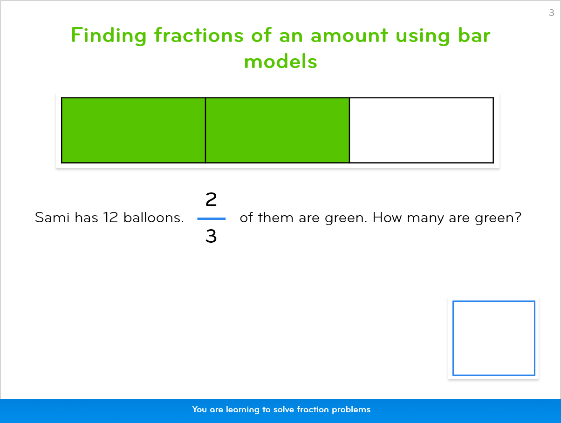
Bar modelling is a particularly effective way to teach fractions. Here is an example involving fractions, solved using a fraction bar model:
On Saturday, Lara read two fifths of her book. On Sunday, she read the other 90 pages to finish the book. How many pages are there in Lara’s book?
Drawing a bar model for what we know:
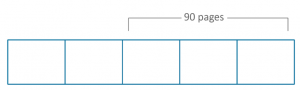
Children can see that they need to divide 90 by 3 (since 90 pages represent three fifths of the book):
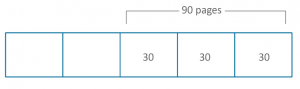
As fractions are equal parts – a concept children should be familiar with from Key Stage 1 – they know that the other two fifths will be 30 pages each:
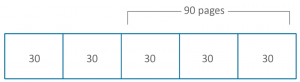
Then calculate 30 × 5 = 150 pages.
Download more bar modelling questions: Let’s Practise Bar Model Fractions
Bar models for ratio and proportion in KS2
Bar models are particularly useful for representing ratio problems visually. For example:
In a class, the ratio of boys to girls is 3:5. There are 24 children in the class. How many are girls?
Children draw a comparison bar model with 3 equal parts for boys and 5 equal parts for girls. The bar model shows that 8 equal parts represent 24 children in total, so each part represents 3 children. Girls = 5 × 3 = 15.
Bar modelling makes ratio problems concrete because children can see the relationship between two quantities represented as rectangular bars. This also supports children’s understanding of proportion – if two thirds of a box of 12 sweets are green, children can divide the bar into 3 equal parts and see that 8 must be green.
Equations with the bar model in KS2
There are lots of other areas where bar modelling supports children’s understanding of mathematical concepts – including equations. Here is an example of using the bar model to solve an equation:
2a + 7 = a + 11
Drawing a comparison bar model, as we know both sides of the equation will equal the same total:
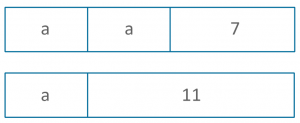
The bars showing 7 and 11 could be any size at this stage, since we do not know their value relative to ‘a’. But the ‘a’ appearing first in both bars must be understood as equal. This allows children to see that to find the second ‘a’ in the top bar, they calculate 11 – 7 = 4.
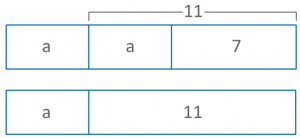
So if a = 4, then both sides of the equation total 15:
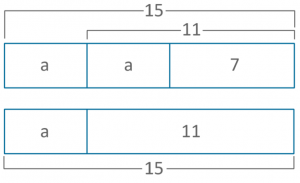
Bar modelling supports algebraic reasoning because it gives children a way to represent unknown quantities visually before they encounter formal algebraic notation. For more on teaching algebra at KS2, see our separate guide. The NCETM identifies bar modelling as a precursor to symbolic algebra – children who can use bar models for “missing number” problems are already developing the conceptual understanding they will need for equations in Key Stage 3 and beyond.
Bar modelling for the KS2 SATs
At the SATs level, most maths problems require multiple steps to solve and incorporate several mathematical concepts – money, fractions, four operations, ratio.
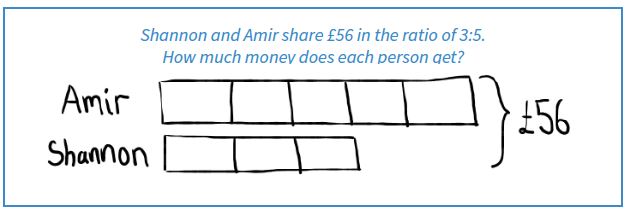
While bar modelling can represent all these steps at once, children may find it easier to identify each step and draw bars separately, forming the answer gradually. Bar models will not solve every multi-step word problem, but they make a significant difference to children’s ability to work through complex problems in the SATs. For more worked examples, see our guide to bar modelling techniques for SATs word problems.
For pupils who need additional support applying bar models to SATs-style questions, one-to-one tutoring can make a real difference. Third Space Learning’s Year 6 SATs tutoring programme, delivered by Skye, includes 60 lessons focused on the 20 topics most likely to help pupils reach the expected standard – with bar models used throughout to help pupils break down multi-step problems and build exam confidence.
Common mistakes when teaching bar models
Bar modelling is a powerful tool, but there are common pitfalls to be aware of when teaching it.
Confusing model types. Children sometimes draw a part-whole bar model when they need a comparison model, or vice versa. Spending time explicitly naming the three bar model structures and practising choosing the right one for different word problems helps address this.
Drawing inaccurate proportions. When children draw bars that are wildly disproportionate (for example, drawing the bar for 5 longer than the bar for 50), it can lead to confusion. Encourage roughly proportional bars, but do not insist on perfection – the purpose of bar modelling is to reveal the structure, not to produce a scale diagram.
Jumping to bar models too early. Bar modelling sits at the pictorial stage of the CPA approach. Children who are not yet secure with concrete representations may struggle to use bar models effectively. Make sure children have worked with concrete objects and concrete resources (cubes, counters, real items) before introducing bar modelling.
Identifying and unpicking these misconceptions in a class of 30 is difficult, which is why one-to-one support makes such a difference for bar modelling. Maths intervention programmes can focus on how a pupil draws and labels their bar models in real time, spotting errors in proportionality or model choice that would go unnoticed in a whole-class setting.
Not progressing to abstract. Equally, some children become reliant on bar models and do not move on to abstract calculations. Bar models are a stepping stone, not a destination. The goal is for children to develop the conceptual understanding that allows them to work with abstract concepts and number sentences independently.
Difficulty with fractions in bar models. Dividing a bar into equal parts for fractions (especially non-unit fractions like two thirds) is a common stumbling point. Children often struggle to draw bars with accurately equal parts. Practising bar modelling with simpler fractions (halves, quarters) before moving to thirds and fifths builds confidence.
Many of these misconceptions are difficult to identify and address in a class of 30. One-to-one maths tutoring gives pupils the space to talk through their reasoning and have specific errors corrected in real time – something Skye, Third Space Learning’s AI maths tutor, is specifically trained to do through spoken, scaffolded conversations.
Supporting SEND children with bar models
For children with SEND or those who find bar modelling particularly challenging, these scaffolds can help:
- Pre-drawn bar model templates – children fill in the labels and values rather than drawing from scratch
- Colour-coded bars – using different colours for known and unknown quantities
- Simplified bar models with fewer sections – building up gradually to more complex problems
- Pairing bar models with concrete resources so children can physically manipulate objects alongside the pictorial representation
- Modelling the thinking aloud as a class before asking children to draw independently
For pupils who need sustained one-to-one practice rather than a single scaffold, Third Space Learning’s offers tutoring for schools via AI tutor Skye who provides tutoring sessions that build bar model skills progressively.
Sessions start with simpler part-whole models before introducing comparison and multi-step problems – matching the pace to the individual pupil.
Schools can schedule Skye sessions to run alongside classroom teaching, so pupils get repeated practice without missing other lessons or relying on already-stretched teaching assistants.
Bar model progression by year group
Bar modelling can be used throughout primary education and is one of the most transferable skills in the primary curriculum. Once pupils can use it for addition in Year 1, the same structures carry through to ratio and algebra in Year 6. For pupils who are finding it hard to keep pace with this progression, an online maths tutor can provide the guided, one-to-one practice needed to strengthen bar model skills at whatever stage the pupil is working at.
Here is a suggested year-by-year progression for bar modelling:
EYFS: Children use concrete objects to represent and solve simple addition problems. No formal bar modelling, but lining up objects and comparing groups lays the groundwork.
Year 1: Introduction to bar models using concrete-to-pictorial progression. Simple addition and subtraction with discrete bar models. Children begin labelling known and unknown quantities.
Year 2: Children use bar models independently for addition and subtraction word problems. Introduction to continuous bar models. Simple multiplication as repeated addition using equal groups bar models.
Year 3: Bar modelling for all four operations. Introduction to comparison bar models for “how many more/fewer” problems. Simple fraction bar models (halves, quarters).
Year 4: Bar modelling for multi-step word problems. More complex fractions with bar models. Introduction to bar models for measurement problems.
Year 5: Bar models for ratio and proportion. More complex fraction bar models including non-unit fractions. Bar models for problems involving decimals and percentages.
Year 6: Bar modelling for SATs-style multi-step problems. Bar models for equations and missing number problems as an introduction to algebra. Children choose independently which bar model type to use for any given problem.
Free bar modelling resources for your primary school
- FREE Ultimate Guide to Bar Modelling (including a bar modelling PowerPoint) – a structure that can be put in place across the whole school to help teachers teach bar models consistently
- FREE KS2 Bar Model Worksheet with blank bar models to support children who need more help using bar models for word problems
- FREE Bar Model CPD video training

RELATED RESOURCES:
- Benefits of following a mastery in maths approach
- Bar modelling applied to improper fractions
- Statistics and data handling with visual representations
- Bar model multiplication and division in depth
If you are looking for more maths resources that help develop maths problem solving techniques, all the White Rose Maths lesson slides contain a mix of fluency, reasoning and problem solving work as well as following a structured CPA approach. On the Third Space Maths Hub you will find resources like Rapid Reasoning (daily word problems) and plenty of worked examples
Bar model FAQs
A bar model uses rectangular bars to represent quantities and their relationships. A number line shows numbers on a continuous scale. Bar models are better for representing part-whole relationships, comparisons between two quantities, and problems involving equal groups. Number lines are better for counting on, counting back, and showing position on a scale.
There are three main types of bar model: the part-whole model (showing how parts combine to make a total), the comparison model (comparing two different quantities), and the equal groups model (showing equal shares or repeated groups). Each is suited to different types of maths problems.
Use bar models whenever children need support to visualise problems and identify which calculation to carry out. Bar modelling is most useful for word problems involving the four operations, fractions, ratio, proportion, and equations. Using the bar model reveals the mathematical structure of a problem – if children can already see the structure, they may not need to draw one.
Start with concrete objects and real-world contexts. Use real items (oranges, cubes, counters) to represent simple addition and subtraction problems, then gradually replace real objects with pictorial representations. By the end of Year 1, children should be able to represent simple word problems using labelled bar models with written numbers. Bar modelling at this stage is about teaching children to identify the important information and represent it visually.
Yes. Bar models support algebraic reasoning by giving children a visual way to represent unknown quantities. A comparison bar model can represent an equation like 2a + 7 = a + 11, helping children see the relationship between the known and unknown values. The NCETM identifies bar modelling as a precursor to formal algebraic notation.
.

DO YOU HAVE STUDENTS WHO NEED MORE SUPPORT IN MATHS?
Skye – our AI maths tutor built by teachers – gives students personalised one-to-one lessons that address learning gaps and build confidence.
Since 2013 we’ve taught over 2 million hours of maths lessons to more than 170,000 students to help them become fluent, able mathematicians.
Explore our AI maths tutoring or find out about an online maths tutor for your school.